
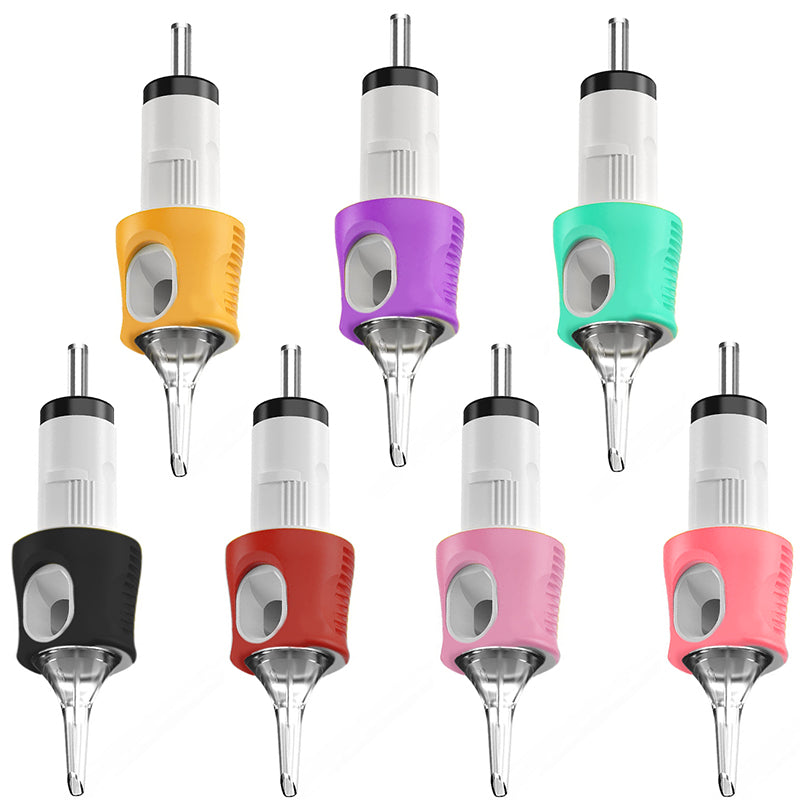
To the untrained eye, most tattoo and PMU cartridges look the same: a plastic shell, a needle, and a rubber membrane.
But for professional artists, the difference is night and day. Why does one cartridge spit ink while another flows smoothly? Why does one feel stable while another wobbles?
The answer lies in fluid dynamics and precision engineering. Today, we take you inside our manufacturing process to reveal the hidden technologies that define a premium cartridge.
1. The Air Vent: It’s Not Just Decoration
(Aerodynamics & Fluid Control)
Have you ever noticed the small hole or slot on the side of the nozzle tip? That is not a design flaw—it is a critical aerodynamic feature.
Breaking the Vacuum Lock: When the needle moves up and down at high speeds, it acts like a piston. Without a vent, the nozzle becomes a sealed vacuum chamber.
- The Problem: The retraction creates a vacuum that sucks ink too deep into the machine, while the push creates high pressure that causes "Ink Spit"—spraying ink over your work.
-
The Solution: Our engineered side vents allow air to flow freely, balancing the internal pressure. This breaks the "vacuum lock," ensuring ink flows down the needle by gravity and capillary action, not by force.

2. The Silicone Finger Ledge: Comfort Meets Precision
(Ergonomics)
Long sessions (3-5 hours) can lead to hand fatigue or "tattoo writer's cramp". That is why our Pro Series features an integrated Soft Silicone Finger Ledge.
- Vibration Absorption: The silicone acts as a damper, absorbing the high-frequency micro-vibrations from the motor before they reach your fingertips. This keeps your hand steady for delicate work like dot-work or hair strokes.
-
Lower Center of Gravity: The ledge is often positioned closer to the skin than a standard plastic grip. This allows you to hold the machine lower, reducing the lever arm and giving you absolute control over the needle tip—just like choking up on a pencil for detailed drawing.

3. Medical Grade PC vs. The Rest
(Material Science)
Not all clear plastic is the same. Low-cost cartridges use standard ABS or PP plastic, which can be cloudy and soft. We strictly use Bayer Medical-Grade Polycarbonate (PC).
-
- Heat & Wear Resistance: High-speed friction generates heat. Ordinary plastic can soften or wear down, creating microscopic plastic dust that mixes with your ink. Our PC shell is as hard and clear as glass, ensuring zero friction and zero contamination even after hours of use.
The "Stabilizer" Ribs: Look closely at our cartridge shell. Inside, you won't find a hollow tube. You will see precision-molded internal ribs (stabilizers). These guide the needle bar, restricting it to a purely vertical movement and eliminating the side-to-side "wobble" that ruins fine lines.
Below is SGS, RoHS and REACH Test report for the plastic material 

-
4. The Invisible Bond: Lead-Free Silver Solder
(Safety Standards)
How the needles are bonded together matters. We adhere to strict RoHS standards by using Lead-Free Silver Solder.
- Unlike cheap lead-based solders, silver solder is stronger, safer, and highly conductive.

Conclusion
A premium cartridge isn't just a needle; it is a complex instrument designed to manage ink flow, vibration, and friction.
When you choose our cartridges, you aren't just buying supplies; you are investing in consistency. No ink spit, no wobble, just pure performance.


Leave a comment
This site is protected by hCaptcha and the hCaptcha Privacy Policy and Terms of Service apply.