

For most professional Permanent Makeup (PMU) machines, there is no standardized digital tolerance because the "displayed depth" is a mechanical setting, not a digital measurement.
In practical terms, the discrepancy between the depth setting on your handpiece and the actual needle protrusion usually falls within a range of 0.2 mm to 0.5 mm, depending on the quality of the machine and the cartridge membrane.
Here is the technical breakdown of why this difference exists and what the realistic tolerance is.
1. Mechanical Tolerance (The "Click" Accuracy)
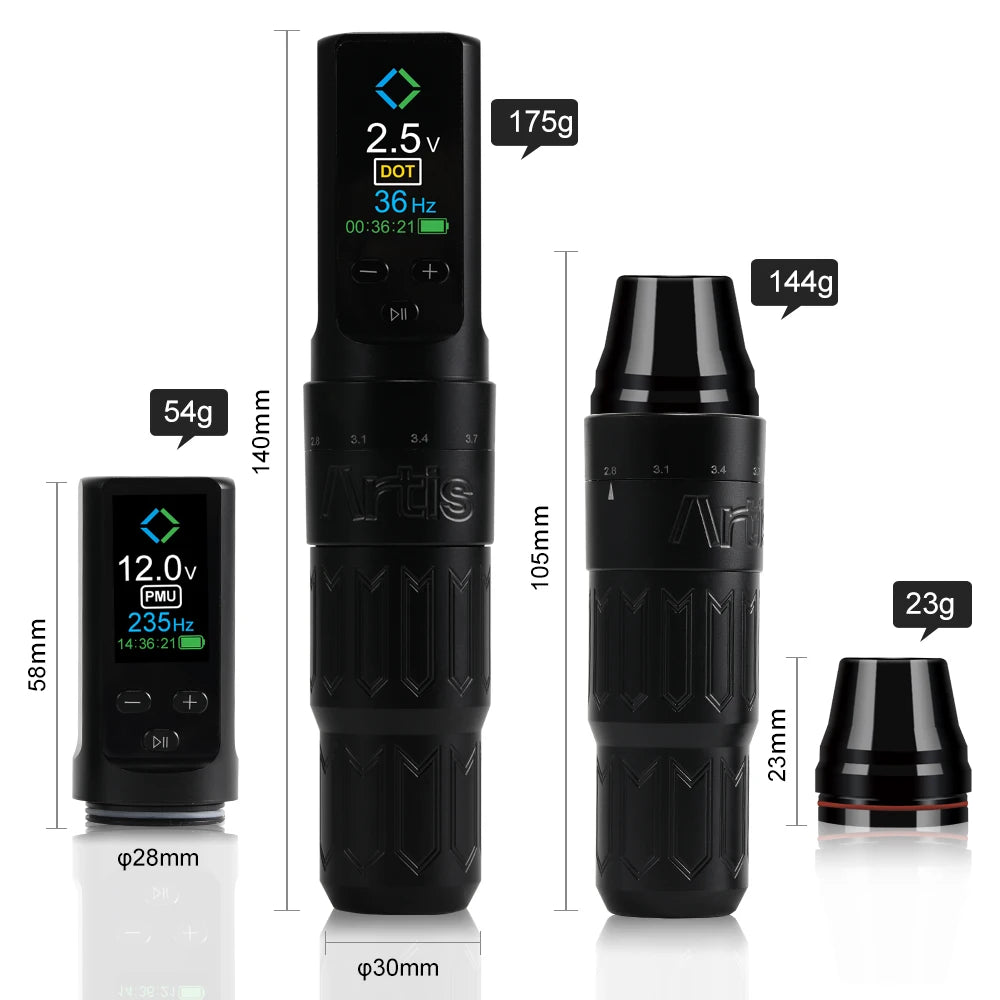
Most high-end PMU machines (e.g., Bellar, Xion, Mast, Nouveau Contour) use a mechanical "click" or twist-grip system to adjust depth.
- Resolution: One "click" typically equals 0.1 mm to 0.25 mm of movement.
- Accuracy: The internal threads are usually precise. If you twist the grip to extend the needle by 1.0 mm, the mechanism physically moves 1.0 mm.
- However, this only measures the movement of the grip, not the final position of the needle tip.
2. The "Membrane Gap" (Displayed vs. Actual)
The largest source of error is the needle cartridge itself.
- Static vs. Dynamic: When you set the depth (e.g., to 2.0 mm) while the machine is running in the air, you are seeing Static Protrusion.
- Membrane Resistance: Inside safety cartridges, a silicone membrane pulls the needle back. As the machine runs, the resistance of this membrane (and the machine's own "give") can slightly shorten the stroke.
- The Result: A machine set to 2.0 mm might only push the needle out 1.7 mm – 1.8 mm during actual operation, creating a tolerance error of roughly ~0.2 mm to 0.3 mm.
3. "Float" vs. "Ride the Tube"
Your actual working accuracy depends on your technique, not just the machine setting:
- Floating the Needle: If you set the needle to stick out 2–3 mm (long hang) but hover your hand so only the tip enters the skin, the "displayed" setting is irrelevant to the depth of implantation.
- Riding the Tube (Capping): If you rest the plastic cartridge tip against the skin, the depth is fixed by your setting. In this method, the tolerance is critical. Due to the "trampoline effect" of the skin (the skin pushing back), the needle often penetrates 0.5 mm less than the protrusion length.
- Example: To hit a target depth of 1.0 mm (dermis), you often need to set the protrusion to 1.5 mm – 1.8 mm to account for skin resistance.
Summary Table: Expected Tolerances
|
Setting Type |
Typical Adjustment Increment |
Expected Variance (Error) |
|
Mechanical Dial |
0.1 mm - 0.25 mm per click |
Very Accurate (<0.05 mm) |
|
Needle Hang (Air) |
N/A |
Accurate to setting |
|
Needle Hang (Under Load) |
N/A |
-0.2 mm to -0.4 mm (Loss due to resistance) |
|
Actual Skin Depth |
N/A |
-0.5 mm (Loss due to skin elasticity) |
Do not rely blindly on the visual scale or number on the grip.
- Zero the Machine: With the motor running, twist the grip until the needle tip just touches the edge of the cartridge tube.
- Count the Clicks: If you know your machine is "0.25 mm per click," four clicks will give you roughly 1.0 mm.
Visual Check: Always visually verify the length while the machine is running (the "eye test") rather than trusting the dial markings, as different cartridge brands have different internal pin lengths that can throw off the scale by up to 1.0 mm.


Leave a comment
This site is protected by hCaptcha and the hCaptcha Privacy Policy and Terms of Service apply.